
Cumulus Quality Execution System


Blog
Before Construction Starts
Stephanie Gotico
November 19, 2026
The 2 to 3 year journey from “we need a data center” to breaking ground, and why most of the timeline happens before anyone picks up a tool.
When people talk about data center schedules, they usually start the clock at groundbreaking. But by the time a shovel actually hits dirt, a project has already been in motion for 2 to 3 years, and tens of millions of dollars and years of work have gone into it before the first crew shows up on site. The build itself is really the last stretch of a much longer process, and once you understand what happens before construction starts, it changes how you think about everything that comes after.
Why the early years matter
It is easy to think of pre-construction as its own world, separate from the work that happens in the field. In reality, the two are tightly connected, because the pressure to compress the construction timeline is partly driven by how long everything before it takes. When pre-construction runs long, that schedule pressure lands on construction and commissioning, which happen to be the phases where quality is most at risk. So the work with the most riding on getting it right ends up with the least time to do it.
The road to breaking ground
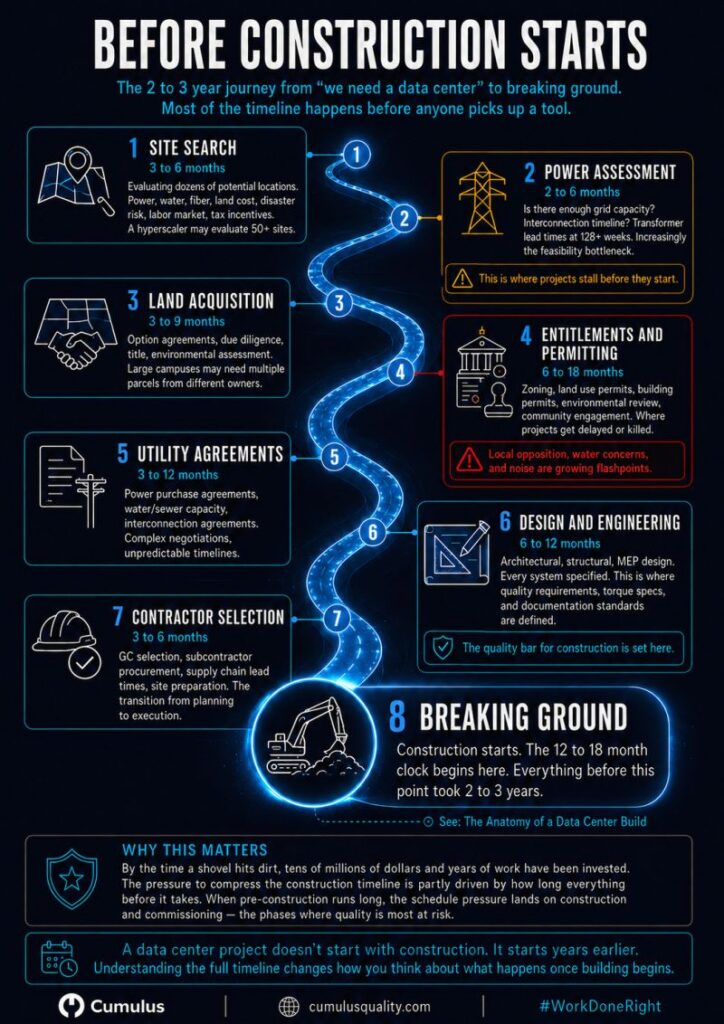
If you follow a single project from the first conversation to the first shovel, there are seven phases it has to get through before construction can begin.
It starts with site search, which usually takes 3 to 6 months. Teams evaluate dozens of potential locations and weigh things like power, water, and fiber access alongside land cost, disaster risk, the local labor market, and available tax incentives. A hyperscaler may look at 50 or more sites before landing on the right one. From there, the power assessment takes another 2 to 6 months as the team works out whether there is enough grid capacity and how long interconnection is going to take. Land acquisition follows at 3 to 9 months, with option agreements, due diligence, title work, and environmental assessments to get through, and larger campuses may need to piece together multiple parcels from different owners.
This is also where the timelines start getting longer and harder to predict. Entitlements and permitting can take anywhere from 6 to 18 months, since a project has to work through zoning, land use and building permits, environmental review, and community engagement. Utility agreements add another 3 to 12 months, because power purchase agreements, water and sewer capacity, and interconnection agreements all have to be negotiated, and those negotiations rarely move on a predictable schedule.
Once the site, the power, and the approvals are in place, design and engineering takes 6 to 12 months to bring together the architectural, structural, and MEP design and specify every system in the facility. The last step is contractor selection, which takes 3 to 6 months and covers choosing the GC, procuring subcontractors, working through supply chain lead times, and preparing the site. That is the point where the project finally shifts from planning to execution.
Where projects stall
Pre-construction rarely falls apart in one dramatic moment. More often, it slows down in a few familiar places.
The first is the power wall. With transformer lead times now at 128 weeks or more, the power assessment has become a feasibility question as much as a planning one, and it is increasingly the bottleneck that decides whether a project can move forward at all. A lot of projects stall right here, before they have really started.
The second is the permitting fight. Permitting is where more projects get delayed or even killed than most people realize, and local opposition, water concerns, and noise are becoming bigger flashpoints in the communities where these facilities are being proposed.
The third is the utility negotiation. Power purchase agreements and water and sewer capacity are not standard paperwork that gets signed and filed. They are complex negotiations with unpredictable timelines, which makes them hard to plan around and easy to underestimate.
Where the quality bar gets set
Of all the pre-construction phases, design and engineering is the one that matters most for quality. This is where the quality requirements, torque specs, and documentation standards for the whole project get defined, so every value that will eventually need to be hit and recorded in the field traces back to decisions made during this phase.
In other words, the quality bar for construction is set long before construction starts, and often before the people who will have to meet that bar are even on the project.
When the clock starts
Breaking ground is where the 12 to 18 month construction clock begins, and everything before that point took 2 to 3 years. By the time crews arrive, the specs are set, the money is committed, and any delays earlier in the process have already made the schedule feel tighter. Construction and commissioning are where the quality bar from design actually gets met, and they are also the phases with the least room to slow down when something comes up.
The one thing to remember
A data center project doesn’t start with construction. It starts years earlier, with a site search, a power study, and a long list of agreements and approvals, and understanding that full timeline changes how you think about what happens once building begins.
When the schedule gets squeezed at the end, the pressure lands on the people doing the most quality-critical work. Giving them a way to get it right the first time, and to prove it, is how you protect all the years of work that came before them.
This is part of an ongoing series of explainers on how demanding construction and industrial work actually gets built and verified. At Cumulus, we help teams capture and verify quality at the point of work, so the proof holds up even when the schedule gets tight. Learn more at cumulusquality.com.


Schedule a demo to see Cumulus in action
Build custom digital workflows to guide field workers
Automate work completion and quality reporting
Integrate with powerful tools and technologies to get real-time work visibility